Summary
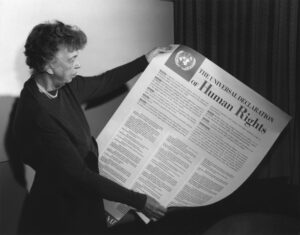
The extreme atrocities of World War II fostered the formation of the United Nations and inspired its assertions that “human rights should be protected by the rule of law” as “essential to promote the development of friendly relations between nations.” The Commission on Human Rights began meeting in February 1947, chaired by Eleanor Roosevelt who presided over an international convening of philosophers, educators, diplomats, labor organizers, and women’s rights advocates, working with the Director of the UN Secretariat’s Division for Human Rights.
The UDHR set out for the first time fundamental human rights to be universally protected although many of its ideals remain only partially realized. It includes 30 articles with the first declaring that “All human beings are born free and equal in dignity and rights.” Article 2 states that these rights apply regardless of “nationality, place of residence, sex, national or ethnic origin, colour, religion, language, or any other status.”
Articles 13-15 concern migration and citizenship and assert freedom of movement and residence—including to leave any country and return to one’s own country; rights to seek asylum and to hold a nationality.
UDHR has provided the foundations for about 70 international agreements such as the United Nations High Commissioner for Refugees Refugee Protocol.
Source
Universal Declaration of Human Rights Excerpt:
Whereas recognition of the inherent dignity and of the equal and inalienable rights of all members of the human family is the foundation of freedom, justice and peace in the world,
Whereas disregard and contempt for human rights have resulted in barbarous acts which have outraged the conscience of mankind, and the advent of a world in which human beings shall enjoy freedom of speech and belief and freedom from fear and want has been proclaimed as the highest aspiration of the common people,..
The General Assembly,
Proclaims this Universal Declaration of Human Rights as a common standard of achievement for all peoples and all nations, to the end that every individual and every organ of society, keeping this Declaration constantly in mind, shall strive by teaching and education to promote respect for these rights and freedoms and by progressive measures, national and international, to secure their universal and effective recognition and observance, both among the peoples of Member States themselves and among the peoples of territories under their jurisdiction…
Article 1
All human beings are born free and equal in dignity and rights. They are endowed with reason and conscience and should act towards one another in a spirit of brotherhood.
Article 2
Everyone is entitled to all the rights and freedoms set forth in this Declaration, without distinction of any kind, such as race, colour, sex, language, religion, political or other opinion, national or social origin, property, birth or other status. Furthermore, no distinction shall be made on the basis of the political, jurisdictional or international status of the country or territory to which a person belongs, whether it be independent, trust, non-self-governing or under any other limitation of sovereignty.
Article 3
Everyone has the right to life, liberty and security of person.
Article 13
- Everyone has the right to freedom of movement and residence within the borders of each state.
- Everyone has the right to leave any country, including his own, and to return to his country.
Article 14
- Everyone has the right to seek and to enjoy in other countries asylum from persecution.
- This right may not be invoked in the case of prosecutions genuinely arising from non-political crimes or from acts contrary to the purposes and principles of the United Nations.
Article 15
- Everyone has the right to a nationality.
- No one shall be arbitrarily deprived of his nationality nor denied the right to change his nationality.